Posted on Leave a comment

Your Audience Is Online — Here’s How to Reach Them, Engage Them, and Convert Them

A Deep Dive into “Digital Dominance: The Complete Guide to Online Marketing & Social Media”

By Bryan | May 9, 2026 | 12-minute read

Digital marketing strategy concept showing online business growth channels and analytics
The digital landscape has never offered more opportunity — or more competition.

For the first time in history, a solo creator working from a kitchen table has access to the same marketing channels as a Fortune 500 company. You can publish content that reaches millions. You can build an email list of 50,000 loyal subscribers. You can run targeted ads to the exact person who needs your product — all without a marketing department, a PR firm, or a six-figure ad budget. The playing field has never been more level.

But here’s the catch: attention has never been more competitive. There are over 500 million active blogs500 hours of video uploaded to YouTube every minute, and billions of social media posts published daily. Everyone is posting. Almost nobody is strategizing. Most businesses are “doing social media” — throwing up random content, chasing vanity metrics, and wondering why nothing converts into actual revenue.

Digital Dominance: The Complete Guide to Online Marketing & Social Media — Build Your Brand, Grow Your Audience, and Generate Revenue Online cuts through the noise with a complete, actionable system. This isn’t another surface-level overview. It’s the single marketing playbook that replaces the 15 different online courses, the scattered YouTube tutorials, and the conflicting advice you’ve been trying to piece together. If you’re ready to stop guessing and start growing, this is where you begin.

What Makes This Book Different

Most digital marketing resources teach you one channel. A course on Instagram. A blog post about SEO. A webinar on email marketing. You learn them in silos — disconnected fragments that never come together into a real strategy.

Digital Dominance is different because it teaches the entire digital marketing ecosystem and — more importantly — how every channel works together as a unified machine. SEO feeds your content marketing. Content marketing feeds your email list. Email drives sales. Paid ads accelerate everything. When you understand how these pieces interlock, you stop wasting effort and start compounding results.

The book also confronts a truth most marketers ignore: your email list is the most valuable digital asset you can build — because you own it. Social media followers? Those live on rented land. An algorithm change, a platform policy update, or a sudden account suspension can wipe out years of work overnight. Your email list can’t be taken from you. Digital Dominance makes sure you understand that distinction from the very beginning.

Content creation and digital marketing strategy planning with multiple social channels
Effective digital marketing connects every channel into one coordinated system.

What You’ll Learn Inside “Digital Dominance”

The book is structured as a 10-chapter value-driven journey — each chapter building on the last, taking you from foundational strategy to advanced execution. Here’s what’s waiting inside:

Chapter 1: Digital Marketing Strategy

Before you post anything, you need a strategy. This chapter maps the complete digital marketing ecosystem and teaches you how to set clear, measurable goals: brand awareness, lead generation, sales conversion, customer retention, and referral generation. You’ll learn the golden rule that saves countless hours of wasted effort — being exceptional on one or two channels beats being mediocre everywhere.

Chapter 2: Content Marketing Mastery

Content marketing builds trust and authority without interrupting people. When someone has read 20 of your articles or watched 50 of your videos, the sale becomes a natural next step — not a hard pitch. Master the 6 content formats that convert: long-form blog posts, video, podcasts, email newsletters, case studies, and templates/tools. And learn the ultimate efficiency hack — repurpose one piece of content across every format so you create once and distribute everywhere.

Chapter 3: SEO Fundamentals

Learn how search engines actually work and how to get your content ranking on Google’s first page. Master keyword research using tools like Ahrefs, SEMrush, and free alternatives. Discover why long-tail keywords (3+ words) are easier to rank for AND convert better than broad, competitive terms. Build content clusters with pillar pages that signal topical authority to Google — the same strategy that top-performing websites use to dominate search results.

Chapter 4: Email Marketing

💰 The ROI That Demands Your Attention

Email marketing delivers $36–42 for every $1 spent — the highest ROI of any marketing channel. Segmented emails get 14% higher open rates and 100% higher click-through rates than unsegmented broadcasts. If you’re ignoring email, you’re leaving serious money on the table.

Learn to build your list with lead magnets, exit-intent popups, and cross-promotion. Discover the segmentation and automation strategies that turn subscribers into buyers on autopilot. Your email list is the one digital asset no algorithm can take from you — this chapter ensures you build it right.

Chapter 5: Social Media Strategy

Not every platform is right for every business. Digital Dominance gives you the complete platform selection guide so you invest your time where it actually matters:

Platform Best For
LinkedIn B2B marketing, professional services, thought leadership
Instagram Visual brands targeting audiences aged 18–45
TikTok Organic viral growth, reaching younger demographics
YouTube Evergreen content, long-form value, search-driven discovery
X (Twitter) Thought leadership, real-time engagement, networking
Pinterest Home, food, fashion, DIY, and lifestyle niches

You’ll also master the 80/20 rule: 80% value, 20% promotion. Audiences that feel constantly sold to will disengage. This chapter shows you how to build genuine connection — and how that connection drives more revenue than any hard sell ever could.

Chapter 6: Paid Advertising

Organic marketing builds long-term compounding assets, but paid ads deliver immediate scale. Learn Google Ads (the highest-intent channel in digital marketing), target a healthy ROAS of 3x or higher, and start testing with just $20–50/day. The ideal strategy: use paid ads to generate revenue quickly, then reinvest profits into organic channels that compound forever.

Chapter 7: Video Marketing & YouTube

The numbers tell the story: viewers retain 95% of information from video versus just 10% from text. Websites with video are 53x more likely to rank on Google’s first page. YouTube is the world’s second largest search engine with 2+ billion monthly users — and unlike other platforms, YouTube content generates traffic and revenue for years, not hours.

🎬 Insider Tip from the Book

Spend 20% of your production time on the title and thumbnail. If nobody clicks, everything else — your script, your editing, your call-to-action — is completely wasted. The click is where everything starts.

Chapter 8: Influencer & Affiliate Marketing

Reach large audiences without building them yourself. Learn why micro-influencers (10K–100K followers) often deliver better ROI than mega-influencers — they have more engaged audiences, higher trust, and lower fees. Set up affiliate programs with 5–30% commissions through platforms like ShareASale and Impact. The best part? You only pay for actual results.

Chapter 9: Analytics & Optimization

The internet’s greatest gift to marketers is data. Learn the complete metrics framework: traffic, engagement, leads, conversion, retention, and ROI. Set up Google Analytics 4 and Search Console. Commit to making at least one data-driven optimization decision every single week. What gets measured gets improved — and this chapter gives you the measurement system to improve everything.

Digital marketing analytics dashboard showing performance metrics and KPIs on a laptop screen
Data-driven decisions separate profitable marketers from everyone else.

Chapter 10: Building a Personal Brand

In a crowded market, people connect with people — not logos. Your personal brand is the most valuable professional asset in the digital age. It follows you across companies and platforms. It opens doors that cold outreach never could.

Learn to define your niche, create consistently, share authentically (including your failures), build in public, and let genuine helpfulness drive everything you do.

“Your personal brand is what people say about you when you’re not in the room.”

— Jeff Bezos

This chapter gives you the blueprint to make sure what they’re saying is exactly what you want them to say.

Who Is This Book For?

This book is for you if…

  • You’re a small business owner who knows you need to be online but don’t know where to start
  • You’re posting on social media but getting zero traction or sales
  • You want to build an email list but have no idea how to start or what to send
  • You’re a content creator looking to monetize your audience
  • You want to understand SEO without needing a computer science degree
  • You’re spending money on ads but have no clue if they’re actually working
  • You want ONE comprehensive playbook instead of stitching together free YouTube tutorials
  • You’re ready to build a personal brand that opens doors for years to come

Whether you’re a solopreneur, freelancer, side hustler, aspiring influencer, or someone who simply knows that attention is the new currency — Digital Dominance meets you where you are and takes you where you want to go.

Key Takeaways You’ll Walk Away With

After reading Digital Dominance, you won’t just understand digital marketing — you’ll have a system you can execute immediately:

  • A complete digital marketing strategy that connects every channel into one unified, revenue-generating system
  • The exact content formats and repurposing strategies that build trust, establish authority, and drive sales
  • SEO and keyword research skills to get your content ranking on Google — without needing a technical background
  • Email marketing mastery — including segmentation, automation, and list-building tactics for the highest-ROI channel most businesses ignore
  • Paid advertising fundamentals that let you scale profitably from day one, even on a small budget
  • A personal branding blueprint that makes you unforgettable in your niche and positions you as the go-to expert

The Playing Field Is Level — Your Move

Entrepreneur building a profitable personal brand online with strategic digital presence
Your online presence is your most powerful business asset. Build it with intention.

The internet has done something unprecedented: it has given you the same tools, the same platforms, and the same reach as billion-dollar brands. The only difference between where you are now and where you want to be is knowing how to use them.

Digital Dominance is that knowledge. It’s not theory from someone who read about marketing in a textbook. It’s a complete, actionable system built for people who are ready to stop scrolling, stop guessing, and start building something real.

Your audience is already online. They’re searching for what you offer. They’re waiting for someone to earn their trust, deliver value, and solve their problems.

Be that someone. Get your copy of Digital Dominance: The Complete Guide to Online Marketing & Social Media today and start turning attention into revenue.

📚 Continue Your Growth Journey

This book is part of a larger collection of transformative reads designed to fuel every dimension of your success. Ready to build the business behind your brand? Check out Launch & Lead: The Complete Guide to Business & Entrepreneurship. Want to sharpen the mindset that drives your hustle? Explore Unleash Yourself: The Complete Guide to Self-Improvement & Motivation. Together, these books give you the strategy, the skills, and the mindset to dominate.

Posted on Leave a comment

Don’t Miss What’s Coming Next — Join Our Growing Community of Readers

,By The Editorial Team  |  May 3, 2026  |  6 min read

A person reading a book by a sunlit window, enjoying a quiet moment of learning and reflection
Your next favorite book is closer than you think.

You’re here for a reason. Maybe you searched for a book that could help you build better habits, start a business, or finally take control of your health. Maybe you stumbled across one of our articles and thought, “This is exactly what I needed to read today.” Whatever brought you here — welcome. You’re in the right place.

But here’s the thing most visitors don’t realize: what you’ve seen so far is just the beginning. We’re building a massive library of transformative books and in-depth content — over 110 titles planned — covering every dimension of personal and professional growth. New releases, deep-dive articles, curated reading guides, and exclusive deals are rolling out on a regular basis.

And the best way to make sure you never miss any of it? Subscribe to our newsletter. Think of it as your VIP pass — subscribers hear about everything first, get access to content nobody else sees, and become part of a community that’s genuinely invested in growth. It takes ten seconds, and it’s completely free.

Why Subscribe? What’s In It for You?

We get it — your inbox is already full. So why add one more newsletter? Because this one actually delivers value you can use. Here’s exactly what you get when you join:

1. First Access to New Releases

We’re building a collection of 100+ books spanning every area of personal and professional growth — from health and wellness to business strategy, from mindset mastery to financial literacy. Newsletter subscribers are the first to know when a new title drops, often before it hits the main store page.

Early access means you never miss a release that could change your trajectory. While everyone else finds out later, you’ll already be reading.

2. Exclusive Articles & Deep Dives

Our blog is packed with in-depth articles breaking down the key insights from each book — actionable takeaways you can start applying immediately. But some of our best content is newsletter-exclusive.

Subscribers get curated reading guides, behind-the-scenes looks at upcoming releases, and bonus content you won’t find anywhere else on the site. If you love going deeper than the surface level, this is where the good stuff lives.

3. Special Promotions & Discounts

We regularly offer subscriber-only deals — bundle discounts, early-bird pricing on new releases, seasonal sales, and exclusive promo codes. If saving money on books that level up your life sounds good, the newsletter is where those deals land first.

No hunting for coupon codes. No wondering if you missed a sale. It all comes straight to you.

4. Curated Recommendations

Not sure which book to read next? Our newsletter includes personalized reading paths and curated “If you liked X, try Y” recommendations based on what’s trending in the community.

Think of it as having a personal book advisor in your inbox — one who knows exactly what’s in our growing library and can match you with your next great read.

5. A Community of Growth-Minded People

When you subscribe, you’re not just getting emails — you’re joining thousands of readers who are actively investing in themselves. Their health, their mindset, their careers, their relationships. You’ll be part of a community that values continuous learning and real transformation over quick fixes.

There’s something powerful about knowing you’re on this journey alongside people who care about the same things you do.

What We’re Building (and Why It Matters)

This isn’t just a bookstore. It’s a growing knowledge hub — a curated ecosystem of books, articles, reading guides, and community resources designed to help you grow in every area that matters.

With over 110 titles planned, we’re covering topics that touch every part of your life:

  • Health & Wellness — nutrition, fitness, energy, and longevity
  • Self-Improvement & Motivation — habits, mindset, and personal mastery
  • Business & Entrepreneurship — from startup ideas to scaling strategies
  • Personal Finance & Investing — building wealth and financial freedom
  • Leadership & Management — guiding teams and organizations
  • Relationships & Communication — deeper connections, better conversations
  • Creativity & Innovation — unlocking original thinking
  • Productivity & Time Management — doing more of what matters
  • Mental Health & Mindfulness — peace, resilience, and clarity
  • And many more…

Every book comes with a dedicated article breaking down its key insights, plus social content, reading guides, and community discussions. The newsletter ties it all together — it’s the thread that connects every new release, article, and resource into one easy weekly or bi-weekly update delivered right to your inbox.

A curated stack of self-help and personal growth books representing transformative reading
A growing library of transformative reads — and we’re just getting started.

What Our Readers Are Already Enjoying

We’re not starting from scratch — the library is already growing, and readers are diving in. Here’s a look at the titles already available:

Thrive: The Complete Guide to Health & Wellness
Transform your body, mind, and energy for life. A comprehensive roadmap to lasting vitality and well-being.

Unleash Yourself: The Complete Guide to Self-Improvement & Motivation
Master your mind and build unbreakable habits. The definitive guide to becoming the best version of yourself.

Launch & Lead: The Complete Guide to Business & Entrepreneurship
From idea to empire. Everything you need to build, grow, and lead a thriving business.

And this is just the beginning. New titles are added regularly, and subscribers always get the first look. By the time a new book shows up on the main page, our newsletter readers have already had early access, exclusive insights, and often a subscriber-only discount.

It Takes 10 Seconds — Here’s How to Subscribe

We’ve made signing up as effortless as possible. Here’s all it takes:

  1. Enter your email address in the signup form below (or in the sidebar/footer on any page)
  2. Hit “Subscribe”
  3. Check your inbox for a welcome email
  4. Start receiving exclusive content, deals, and new release alerts

That’s it. No spam, no fluff — just real value delivered straight to your inbox. And you can unsubscribe anytime with one click (but we really don’t think you’ll want to).

💡 A Thought Worth Keeping

“The best investment you can make is in yourself. The best way to stay on that path? Surround yourself with the right knowledge. Subscribe and never miss a beat.”

Your Growth Journey Deserves a Companion

Here’s something worth remembering: growth isn’t a one-time event. It’s not a single book you read or a single article that inspires you on a random Tuesday. It’s a continuous journey — and like any journey, it’s easier when you have the right companion.

That’s what this newsletter is. Every edition delivers something that can move the needle in your life, your career, or your health. A new book recommendation. An exclusive article. A deal that saves you money on your next read. A reminder that you’re part of a community of people who believe in getting better every single day.

Don’t let the next game-changing book or insight slip by while you’re not looking. You found us for a reason — now let’s make sure we stay connected.

Join the community. Stay in the loop. Keep growing. Subscribe today.

Ready to stay ahead? Join thousands of readers who never miss a release.

← Back

Thank you for your response. ✨

No spam, ever. Unsubscribe anytime with one click.

Posted on Leave a comment

How the solopreneur business model works and how to build one

Solopreneur working at home with sunlight

Most people assume that working alone in business means you’re a freelancer. That assumption costs aspiring entrepreneurs years of confusion and missed opportunity. The solopreneur business model is something fundamentally different: it’s about building scalable systems for passive income rather than simply trading hours for dollars. In this guide, you’ll learn exactly what separates solopreneurs from freelancers and traditional entrepreneurs, discover the core building blocks of this model, understand the real opportunities and risks in 2026, and walk away with a concrete action plan to launch your own solo business.

Table of Contents

Key Takeaways

Point Details
Solopreneurs build systems Solopreneurs focus on creating income through scalable systems, not just trading time.
Lifestyle-first approach Solopreneurship prioritizes control and balance over building a large team or chasing massive scale.
AI and tech unlock growth Modern tools let solopreneurs do more solo, but genuine scale still has limitations.
Know the risks High autonomy comes with risks of income instability and burnout, requiring realistic expectations.
Simple systems win Straightforward, repeatable systems often outperform complex strategies in solo businesses.

Solopreneurship explained: What sets it apart

Now that we’ve identified major misconceptions, let’s clarify what truly defines solopreneurship and how it stacks up against more familiar solo work and traditional business creation.

A solopreneur is a single owner who runs their entire business without employees, but the key distinction is how they generate income. Instead of selling hours directly, solopreneurs build systems, products, and processes that generate revenue repeatedly. Think of it as building a machine that earns while you sleep, rather than clocking in and clocking out.

“Solopreneurs differ from freelancers by building scalable systems for passive income rather than trading time for money; from entrepreneurs by avoiding teams and focusing on lifestyle over massive scale.” — ADP

The lifestyle-first philosophy is central here. Solopreneurs are not trying to build the next billion-dollar company or manage a team of fifty. They want direct ownership, personal freedom, and a business that fits around their life rather than consuming it. That’s a fundamentally different goal from a startup founder or a corporate entrepreneur, and it shapes every decision they make. Exploring solopreneurship and flexibility reveals just how many people are choosing this path precisely because it puts them in the driver’s seat.

Here’s a clear comparison so you can see the differences at a glance:

Aspect Solopreneur Freelancer Entrepreneur
Income style Scalable, often passive Time-for-money Revenue through team output
Scaling approach Systems and automation More hours or clients Hiring and delegation
Team size Solo (no employees) Solo (no employees) Typically 1 or more hires
Lifestyle focus Central priority Secondary Often sacrificed for growth
Business ownership Full, direct ownership Self-employed contractor Shared or investor-backed

The table makes one thing clear: solopreneurs and freelancers may look similar from the outside, but their internal logic is completely different. A freelance graphic designer charges per project. A solopreneur graphic designer might sell a Canva template pack that generates sales every single day without additional work. Same skill set, radically different model.

Why do people choose this path? Autonomy is the biggest driver. You control your schedule, your clients, your income streams, and your growth pace. There’s no boss to answer to and no investor to satisfy. For many people, that kind of direct ownership over their professional life is worth more than a higher salary or a larger team.

Solopreneur balancing work from kitchen

Essential elements of a solopreneur business model

With a clear understanding of what solopreneurship entails, let’s explore the essential pieces that make a solopreneur business truly thrive.

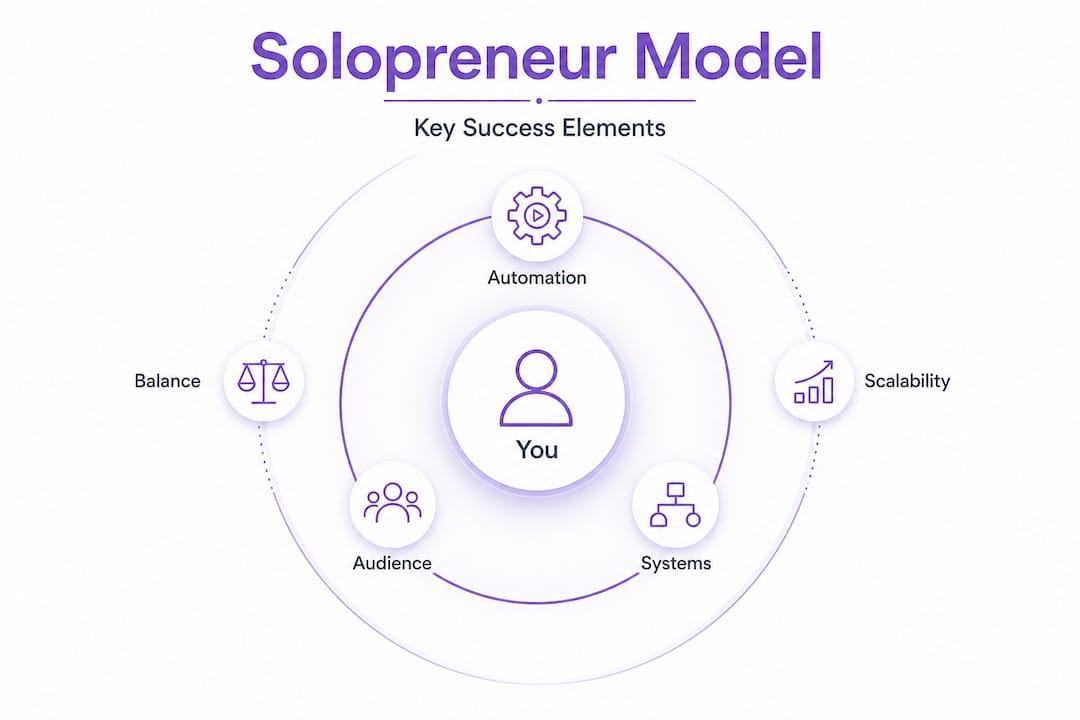
Hierarchy infographic of solopreneur business model

Every successful solopreneur business is built on a handful of core ingredients. Miss one, and the whole model becomes fragile. Get them right, and you create something that genuinely works for you long-term.

The core building blocks include:

  • 🎯 One-person ownership with full operational control
  • ⚙️ Scalable offerings such as digital products, templates, courses, or memberships
  • 🤖 Automation tools that handle repetitive tasks like email sequences, invoicing, and social scheduling
  • 📣 A clearly defined audience that you serve consistently
  • 💰 Multiple income streams that reduce dependence on any single source

The income stream question is where most beginners get stuck. Solopreneurs who build scalable systems typically combine several revenue sources. Digital products like eBooks, templates, and Notion dashboards are popular because they require one-time creation and can sell indefinitely. Online courses and workshops generate income from expertise. Affiliate marketing earns commissions by recommending tools you already use. Subscription newsletters or membership communities create predictable monthly recurring revenue, which is the holy grail for financial stability.

Automation is the engine underneath all of it. Tools like email marketing platforms, social media schedulers, payment processors, and AI writing assistants allow a single person to operate what would otherwise require a small team. The role of AI in solo businesses has grown dramatically, with tools now capable of handling customer support drafts, content repurposing, SEO research, and even basic bookkeeping.

Pro Tip: Don’t try to automate everything at once. Pick the one task that eats the most of your time each week and automate that first. Build from there. Complexity added too early becomes a liability, not an asset.

The clearer your audience, the more effective every other element becomes. A solopreneur who serves “busy working moms who want to start a side business” will create far more resonant products, content, and offers than one who tries to serve “anyone interested in business.” Specificity is your competitive advantage when you’re operating alone.

Knowing the structure of a solopreneur model, it’s critical to understand the current landscape, including both the hype and the hard realities.

The solopreneur space in 2026 looks genuinely exciting. Lower barriers to entry, powerful AI tools, and an explosion of digital platforms mean that a single motivated person can build a credible, revenue-generating business faster than ever before. Zoom has even recognized AI-powered businesses of one with its inaugural Solopreneur 50 list, signaling that the business world is taking this model seriously.

But there’s a gap between the hype and the reality. The “one-person unicorn” narrative, where a solo founder builds a multi-million dollar business entirely alone, makes for great headlines. In practice, AI enables growth but the hype often exceeds reality. Most solopreneurs build profitable lifestyle businesses, not unicorns, and that’s perfectly fine. The problem comes when people chase the unicorn story and burn out chasing metrics that don’t match their actual goals.

Here’s an honest look at what the current landscape offers:

Opportunity Challenge
AI tools dramatically reduce operational workload Learning curve for new tools takes real time
Digital platforms give global reach from day one Crowded markets make differentiation harder
Low startup costs compared to traditional business Income volatility is real, especially in year one
Flexible work location and schedule Isolation and lack of peer accountability
Multiple income stream options Managing all business roles alone creates burnout risk
Growing cultural acceptance of solo business Health insurance and benefits require self-management

Here’s a quick checklist to evaluate if solopreneurship fits your life right now:

  1. Do you have a marketable skill or expertise that others would pay for?
  2. Are you comfortable with income uncertainty for at least 6 to 12 months?
  3. Can you work independently without daily structure or a manager?
  4. Are you willing to learn basic marketing, sales, and operations?
  5. Do you value lifestyle flexibility more than rapid team-based growth?
  6. Do you have at least a small financial cushion to cover startup costs?

If you answered yes to most of these, you’re in a strong position to explore this path seriously. If several answers were no, that doesn’t mean solopreneurship is off the table. It means you have specific gaps to address before you launch.

The burnout risk deserves special attention. When you’re the marketer, the product creator, the customer service rep, and the accountant, mental fatigue builds quickly. Building rest and recovery into your business model from the start isn’t a luxury. It’s a survival strategy.

How to launch and grow as a solopreneur

If you’re inspired by new possibilities and prepared for the realities, here’s a step-by-step guide to get your solopreneur business started on the right foot.

The biggest mistake new solopreneurs make is building complex systems before they’ve validated their idea. You don’t need a polished website, a full course library, or a sophisticated email funnel on day one. You need one offer that solves a real problem for a real person, and you need to sell it before you over-engineer it.

Your launch roadmap:

  1. Define your niche and audience. Get specific. Who exactly do you help, and what exact problem do you solve? Write it in one clear sentence.
  2. Validate your offer. Talk to 10 potential customers before building anything. Ask about their problems, not about your solution. Let their words shape your offer.
  3. Create a Minimum Viable Offer (MVO). This is your simplest, fastest-to-deliver version of your product or service. A single workshop, a template pack, or a short consulting call all qualify.
  4. Set up your core systems. You need a payment processor, a simple landing page, and an email list. That’s it to start. Everything else can come later.
  5. Acquire your first customers. Use content marketing for solopreneurs to attract organic attention, or reach out directly to your network. Your first ten customers will teach you more than any course.
  6. Collect feedback and optimize. After every sale, ask what worked and what didn’t. Use that feedback to improve your offer before you scale anything.
  7. Add automation and additional income streams. Once your core offer is validated and selling, layer in automation to reduce your time investment and add complementary income streams.

The validation step is where most people skip ahead too quickly. They spend three months building a course, launch it to silence, and conclude that solopreneurship doesn’t work. What actually happened is they built before they listened. Solopreneurs who focus on scalable systems still start with a clear, proven demand before they build the system around it.

Pro Tip: Your Minimum Viable Offer doesn’t need to be digital. A live workshop over video call, a one-page PDF guide, or even a 30-minute consulting session can validate demand faster than any automated funnel. Sell first, then systematize.

Content marketing is the most cost-effective growth channel for most solopreneurs. A consistent blog, newsletter, or social presence builds trust, attracts your ideal audience, and creates compounding visibility over time. You don’t need to be everywhere. Pick one or two channels where your audience already hangs out and show up consistently.

What most guides miss about building a solopreneur business

Here’s the uncomfortable truth that most solopreneur content won’t tell you: the people who succeed long-term are rarely the ones with the most sophisticated systems. They’re the ones with the simplest, most repeatable ones.

The internet is full of solopreneur blueprints that involve seventeen tools, complex automation sequences, and multi-funnel content strategies. Aspiring solopreneurs read these guides, feel overwhelmed, and either give up or spend months building infrastructure instead of building revenue. We’ve seen this pattern repeat constantly.

The hidden power of low-tech, easily repeatable systems is that you can actually run them. A simple weekly email newsletter you genuinely enjoy writing will outperform a complex automated sequence you built once and never touch. A single digital product you know deeply will sell better than a sprawling course library you created to look comprehensive.

The optimistic narrative around AI-powered growth is real but incomplete. Yes, AI tools can multiply your output. But they can also multiply your complexity and your distraction. The solopreneurs thriving in 2026 are not the ones using the most AI tools. They’re the ones using a few tools extremely well while staying focused on their core offer and audience.

There’s also a deeper point about lifestyle that most business content misses entirely. Solopreneurship is supposed to serve your life, not replace it. If you’re working 70-hour weeks chasing passive income, you’ve recreated the very trap you were trying to escape. We’ve found, and real stories of solopreneurs confirm this, that the people who build the most sustainable businesses are the ones who treat their own time and health as non-negotiable assets. Your energy is your most important business resource. Protect it with the same discipline you’d apply to protecting your revenue.

Balancing ambition with personal wellbeing isn’t a soft concept. It’s a hard business strategy. A burned-out solopreneur can’t create, market, or sell. A rested, focused one can do all three consistently for years.

Build your solopreneur dream with Digital Mint Art

Ready to turn inspiration into action? You’ve just covered the full landscape of the solopreneur business model, from its core principles to launch steps and the real challenges ahead. That knowledge is powerful, but the next step is finding the right resources to support your journey.

https://digitalmint.art

At Digital Mint Art, we’ve built a knowledge hub specifically for aspiring solopreneurs and entrepreneurs like you. Whether you’re looking for frameworks to clarify your business model, guides to sharpen your mindset, or practical tools to move faster, you’ll find solopreneur tools and resources designed to meet you exactly where you are. You can also explore encouraging stories from real people building real businesses on their own terms. Your next step starts here.

Frequently asked questions

How is a solopreneur business model different from freelancing?

Solopreneurs build systems for passive or scalable income, while freelancers sell their time directly for money. The core difference is that solopreneurs build scalable systems rather than exchanging hours for a paycheck.

Can a solopreneur business really scale without a team?

Yes, solopreneurs leverage automation and digital tools to grow income, though massive scale often still requires outside help. AI enables one-person growth, but the hype around limitless solo scaling exceeds what most people will realistically achieve.

What are the common risks of solopreneurship?

Common risks include income volatility, burnout, and the challenge of managing all business roles alone. Both optimistic and realistic views of solopreneurship acknowledge that high failure rates and low average income in early stages are real factors to plan for.

Is solopreneurship only for digital businesses?

While digital tools make it significantly easier to operate solo, solopreneurship can absolutely work in physical or hybrid models where smart systems enable one person to run operations efficiently.

Article generated by BabyLoveGrowth

Posted on Leave a comment

How to launch a business with no money: step-by-step guide

Woman planning business at dining table

Most aspiring entrepreneurs stop before they start because they believe a lack of funding is a dead end. It isn’t. Bootstrapping involves starting and growing a business using personal finances, revenue, or minimal resources without external investment, and thousands of founders have used this approach to build profitable companies from scratch. This guide walks you through every stage, from shifting your mindset to validating your first paying customer, so you can launch, grow, and prove your idea works without waiting for a check that may never come.


Table of Contents

Key Takeaways

Point Details
Bootstrapping mindset Resourcefulness and discipline are more important than money when launching a business.
Leverage current assets Start by using your existing skills, experiences, and available tools to minimize costs.
Use free digital tools Many free and low-cost platforms enable you to quickly build and test your business idea.
Validate before scaling Test your idea for real customer demand before investing significant time or money.
Scarcity drives innovation Limited funds can help you focus, adapt quickly, and build a stronger, more sustainable business.

Understand the bootstrapping mindset

Having set expectations about launching with limited resources, the most important move you can make is a mental one. Before you touch a single tool or write a single business plan, you need to rewire how you think about money, resources, and progress.

“Bootstrapping involves starting and growing a business using personal finances, revenue, or minimal resources without external investment.” — JP Morgan Business Insights

This definition matters because it reframes the situation. You are not “broke.” You are resourceful. Some of the most recognized companies in the world started with almost nothing. Mailchimp was bootstrapped for years before becoming a billion-dollar platform. GitHub launched on a shoestring before raising a single dollar of outside funding. These entrepreneurial stories prove that constraints can sharpen your thinking rather than limit it.

What bootstrapping actually looks like in practice:

  • Reinvesting early revenue instead of drawing a salary in the first months
  • Using existing skills as your primary product or service
  • Trading services with other small businesses to fill gaps
  • Saying no to overhead like office space, staff, and expensive software until revenue justifies it
  • Making decisions fast because you cannot afford to sit on a problem

The discipline this builds is extraordinary. When every dollar counts, you stop making emotional decisions and start making strategic ones. You learn to prioritize ruthlessly, which is a skill that even well-funded founders often lack.

Pro Tip: The biggest mindset trap is comparing your Day 1 to someone else’s Year 5. Focus on your next $100, not your first million. Momentum compounds, but only if you start.


Evaluate your assets and choose a low-cost business idea

Now that you have the right mentality, it’s time to identify what you already have and which types of businesses you can realistically begin with close to zero budget.

Start by doing a personal asset inventory. Grab a notebook and answer these questions honestly: What skills do you have that others would pay for? What equipment or tools do you already own? Do you have a workspace, even a kitchen table? What professional or personal networks can you tap? What problems have you personally solved that others still struggle with?

Man making personal asset inventory at home

Your answers are your starting capital. A graphic designer with a laptop and Adobe skills has everything needed to launch a freelance studio today. A former teacher with communication skills can start a tutoring or coaching business this week.

Popular low-cost or no-cost business models:

  • Freelancing (writing, design, coding, video editing)
  • Consulting (marketing, finance, HR, operations)
  • Dropshipping (sell products online without holding inventory)
  • Digital products (e-books, templates, courses, printables)
  • Content services (social media management, copywriting, SEO)
  • Virtual assistance (admin, scheduling, research for businesses)
  • Online tutoring or coaching (academic, fitness, career)

Comparing low-cost business models

Business model Key skills needed Estimated startup cost Time to first revenue
Freelancing Writing, design, or coding $0 to $50 1 to 2 weeks
Consulting Industry expertise $0 1 to 4 weeks
Dropshipping Marketing, research $0 to $100 2 to 6 weeks
Digital products Content creation $0 to $30 2 to 8 weeks
Content services Communication, SEO $0 1 to 3 weeks
Online coaching Teaching, empathy $0 to $20 1 to 3 weeks

Step-by-step process for choosing your business idea:

  1. List your top three skills that someone would pay for right now.
  2. Search for demand by browsing job boards, freelance platforms, and social media groups to see what people are hiring for.
  3. Identify the overlap between what you can do and what the market is actively seeking.
  4. Test your passion by asking yourself if you could talk about this topic for an hour without losing energy.
  5. Assess feasibility by confirming you can deliver results with the tools you currently own.
  6. Pick one idea and commit. Spreading across multiple ideas at launch is one of the fastest ways to stall.

According to JP Morgan’s bootstrapping guide, building from personal finances and existing resources is not just a fallback strategy. It is a legitimate and often superior path to building a sustainable business because it forces you to stay close to your customers and your cash flow from day one.


Leverage digital tools and platforms to get started

With your business idea in hand, the next step is to turn your concept into reality using digital resources that minimize or eliminate up-front investment.

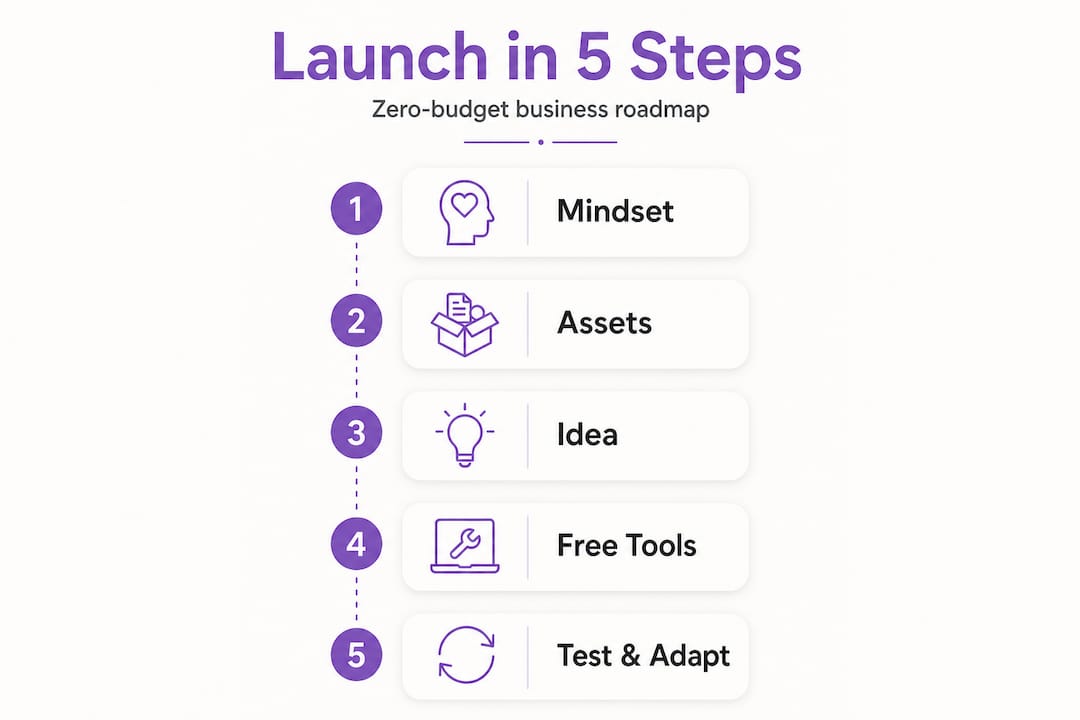
Infographic five step roadmap for launching business

The internet has made it possible to look professional, reach customers, and process payments without spending a cent in the first phase. You just need to know where to look.

Essential free or ultra-low-cost digital tools:

  • Canva for designing logos, social graphics, and marketing materials
  • Google Workspace free tier for email, documents, and spreadsheets
  • Notion for organizing your business plan, tasks, and client notes
  • Mailchimp free plan for building an email list and sending campaigns
  • Wave for free invoicing and basic accounting
  • Zoom free tier for client calls and consultations
  • Buffer or Later free plans for scheduling social media posts
  • Linktree for creating a simple link-in-bio page before you have a website

Platform comparison for building your web presence

Platform Best for Cost Ease of use
Carrd Simple portfolio or landing page Free to $19/year Very easy
Etsy Selling physical or digital products Free to list, 6.5% fee Easy
Gumroad Selling digital products and courses Free, 10% fee on sales Very easy
Shopify Full e-commerce store $29/month after trial Moderate
WordPress.com Blog or content-based business Free tier available Moderate

Notice that the top three options in that table cost nothing to start. You can launch a digital product shop on Gumroad today, list handmade goods on Etsy this afternoon, or publish a portfolio site on Carrd before dinner. The barrier is not money. It is action.

To validate your idea for free before building anything, post in relevant Facebook Groups, Reddit communities, or LinkedIn groups. Describe the problem you solve and ask if anyone would be interested in a solution. If people respond with enthusiasm or ask how to buy, you have early demand. That is worth more than any market research report.

Solid content marketing tips can also help you attract your first audience organically without spending on ads. Publishing consistent, helpful content positions you as an authority and drives traffic to your digital product shop or service page over time.

Pro Tip: Most premium tools offer free trials ranging from 7 to 30 days. Map out your launch timeline so you activate trials strategically, right when you need them most, rather than letting them expire unused.


Test, adapt, and validate your business idea

Once online and operational, the most important phase is real-world testing and rapid, low-cost improvement to maximize your chance of lasting success.

Too many first-time entrepreneurs spend weeks perfecting a website, a logo, or a product before a single customer has seen it. This is where budgets get burned and motivation dies. The smarter path is to get something in front of real people as fast as possible and let their behavior tell you what to build next.

Step-by-step process for testing your business idea:

  1. Find your first potential customer by reaching out directly through social media, email, or in-person conversations. Do not wait for them to find you.
  2. Offer a free or discounted trial in exchange for honest, detailed feedback. This is not charity. It is research.
  3. Ask specific questions: What did you like? What confused you? Would you pay for this? What would make it better?
  4. Measure actual demand by tracking how many people you contacted versus how many said yes. A 10 to 20 percent conversion rate from cold outreach is a strong signal.
  5. Adapt your offer based on what you hear. Change your pricing, packaging, or messaging before investing more time.
  6. Repeat the cycle until you have three to five paying customers. At that point, you have proof of concept.

“The biggest risk is not taking any risk. In a world that is changing really quickly, the only strategy that is guaranteed to fail is not taking risks.” — Mark Zuckerberg

This quote applies directly to validation. The risk of launching imperfectly is far smaller than the risk of never launching at all. Real entrepreneur success stories almost always include a messy, imperfect first version that got better because of customer feedback, not in spite of it.

The bootstrapping principle of using minimal resources applies here too. You do not need a polished product to validate demand. You need a clear promise and a way to deliver on it.

Pro Tip: Build an MVP, which stands for Minimum Viable Product. This is the simplest version of your offer that still delivers real value. If you want to sell an online course, your MVP could be a live workshop over Zoom. Sell the workshop first. Build the course only after people pay for it.


What most advice on launching with no money misses

Here is the uncomfortable truth that most startup guides skip over: limited resources are not a handicap. They are a filter.

When you cannot afford to run ads, you are forced to talk to real customers. When you cannot hire a team, you learn every function of your business deeply. When you cannot afford to pivot slowly, you move fast and stay close to what the market actually wants. These are not consolation prizes. They are competitive advantages.

Conventional advice often pushes founders toward seeking investment as quickly as possible, as if outside funding is the validation that your idea is real. But lean growth strategies tell a different story. Businesses that grow on their own revenue tend to build stronger unit economics, meaning they understand exactly what it costs to acquire and serve a customer, because survival depended on it from the start.

Think about it this way. A funded startup can afford to be sloppy. A bootstrapped founder cannot. That pressure creates clarity. You stop chasing vanity metrics like social media followers and start obsessing over the only number that matters early on: paying customers.

Many iconic businesses, from Apple in a garage to Spanx with $5,000 in savings, started with almost nothing. Sara Blakely, founder of Spanx, did not take outside investment for years. She stayed lean, stayed focused, and built a billion-dollar brand on her own terms. That is not an anomaly. That is a pattern.

The advice we rarely see is this: your first job is not to scale. It is to survive long enough to learn. Scarcity teaches you that lesson faster than any MBA program or investor pitch deck ever could.


Launch and grow with the right resources

Equipped with a plan, here’s how you can use our resources to accelerate your bootstrapped launch.

You have the mindset, the strategy, and the tools. Now it’s time to execute with support built specifically for entrepreneurs who are building from the ground up. At Digital Mint Art, we have put together a collection of practical business-building resources including templates, guides, and frameworks designed to save you hours of trial and error.

https://digitalmint.art

Whether you need a content strategy template, a business plan framework, or a step-by-step launch guide, these digital resources are built for founders who need to move fast without wasting money. Browse the shop and find tools that match exactly where you are in your journey. And if you want ongoing motivation and real encouraging stories from entrepreneurs who built from nothing, the Digital Mint Art platform is your go-to hub for staying focused and inspired every step of the way.


Frequently asked questions

Can I really start a business with zero money?

Yes, many successful businesses are launched through bootstrapping, which means leveraging skills and tools to deliver value before spending any funds. The key is starting with what you already have.

What’s the best business to start with no money?

Freelancing, digital content services, consulting, and dropshipping are strong options because they require minimal upfront investment and can generate revenue within days or weeks of launching.

How can I build a website for free?

You can use free platforms like Carrd, Gumroad, or Etsy to launch a basic business presence without paying for hosting or design, and upgrade only when your revenue supports it.

What’s the biggest mistake when starting with no money?

The most common and costly mistake is spending before validating demand. Build your MVP, get paying customers, and then invest in growth tools and infrastructure.

Article generated by BabyLoveGrowth

Posted on Leave a comment

From Side Hustle to Empire — The Only Business Book That Covers the Entire Journey

Every empire starts with a single, validated idea — and a complete plan to bring it to life.

Every empire starts with a single, validated idea — and a complete plan to bring it to life.

By The Editorial Team  |  May 2, 2026  |  12 min read

Entrepreneurship is the closest thing to a superpower in the modern economy. It gives you the ability to create value out of thin air, build generational wealth, employ others, solve real-world problems, and design a life entirely on your own terms. That’s not hyperbole — it’s the opening thesis of Launch & Lead: The Complete Guide to Business & Entrepreneurship, and after reading it, you’ll understand exactly why.

But here’s the problem most aspiring entrepreneurs face: the business book landscape is hopelessly fragmented. Marketing books don’t teach you financial management. Sales books don’t teach you how to scale operations. Leadership books don’t teach you how to validate an idea before you sink your savings into it. You end up buying 15 different books and still feel like you’re missing critical pieces of the puzzle.

Launch & Lead is different. It covers the complete entrepreneurial journey — from validating your very first idea to building systems that let the business run without you. Think of it as the single playbook every entrepreneur needs, whether you’re scribbling your first business concept on a napkin or preparing to sell a company you’ve built from scratch.

What Makes This Book Different From Every Other Business Book

Let’s get one thing straight: Launch & Lead isn’t theory from academics who’ve never built anything. It’s a practical, evidence-based field manual that synthesizes the best frameworks from the world’s most respected business minds into one actionable system.

We’re talking Peter Drucker’s management principles. Eric Ries’s Lean Startup methodology. Seth Godin’s Permission Marketing revolution. Robert Cialdini’s science of persuasion. Michael Gerber’s E-Myth framework. Richard Branson’s fearless approach to leadership. The book doesn’t just name-drop these thinkers — it weaves their most powerful ideas into a step-by-step playbook you can execute immediately.

“The entrepreneur always searches for change, responds to it, and exploits it as an opportunity.”

— Peter Drucker, as quoted in Launch & Lead

Most importantly, it covers every stage of growth from $0 to $10M+ and gives you the exact strategies for each stage. Whether you’re pre-idea or pre-exit, this book meets you where you are — and shows you precisely where to go next.

What You’ll Learn Inside “Launch & Lead”

This isn’t a book you skim. It’s a book you work through. Each of the 10 chapters delivers a specific transformation — here’s the journey that awaits you.

Chapter 1: The Entrepreneurial Mindset

The difference between entrepreneurs and employees isn’t risk tolerance — it’s how you view problems. Employees see obstacles. Entrepreneurs see opportunities. Every unsolved problem is a potential business waiting to be built.

This chapter unpacks the 6 core traits that separate successful founders from everyone else and introduces a fundamental principle: the best entrepreneurs don’t trade time for money — they build machines that earn while they sleep.

Chapter 2: Finding & Validating Your Business Idea

The startup graveyard is full of technically excellent products that nobody wanted. This chapter hands you a business idea validation framework that prevents you from wasting months building the wrong thing.

The method is deceptively simple: talk to 20–30 potential customers before building anything. Sell before you build. And use the one question that cuts through all wishful thinking: “Would you pay $X for this today?” You’ll also master market sizing with TAM, SAM, and SOM — so you know exactly how big your opportunity is.

Chapter 3: Business Models & Revenue Streams

Your business model choice is often more important than your product choice. The same product can fail spectacularly or thrive wildly depending on how it’s monetized.

Compare SaaS, E-Commerce, Marketplace, Service, and Franchise models side by side. Learn why Amazon started as a bookstore but made its fortune in cloud computing — and why you should never stop looking for adjacent value in your own business.

Chapter 4: Building Your MVP (Minimum Viable Product)

Eric Ries changed the startup world with one idea: ship earlier than feels comfortable. If you’re not embarrassed by your first version, you waited too long.

💡 5 MVP Strategies You’ll Master

Landing Page MVP — Test demand with a simple page before building anything. Wizard of Oz MVP — Manually deliver the service behind the scenes. Concierge MVP — Serve customers one-on-one to learn exactly what they need. Prototype MVP — Build a basic working version. Single-Feature MVP — Launch with one killer feature and iterate from there.

You’ll also master the Build-Measure-Learn loop and learn the critical difference between actionable metrics (which drive decisions) and vanity metrics (which just make you feel good).

Chapter 5: Marketing Fundamentals

Marketing is not manipulation — it’s communication. This chapter walks you through Seth Godin’s paradigm shift from interruption marketing to permission marketing and shows you how to build a crystal-clear customer avatar.

“Fix the leakiest part of your funnel first. If 1,000 people visit your site but only 1 buys, improving conversion beats increasing traffic every single time.”

— From Launch & Lead, Chapter 5

You’ll master the complete marketing funnel strategy from Awareness to Advocacy — and learn exactly where to focus your limited time and budget for maximum impact.

Chapter 6: Sales Mastery

Great salespeople don’t sell — they help people buy. This chapter breaks down Robert Cialdini’s 6 principles of persuasion (reciprocity, commitment, social proof, authority, liking, and scarcity) and maps them onto a complete sales process from prospecting to closing.

Here’s a stat that will change how you sell: top salespeople talk less than 40% of the time. The most powerful sales skill is listening. And objections aren’t rejections — they’re requests for more information.

Chapter 7: Financial Management for Entrepreneurs

The #1 cause of startup failure isn’t bad products — it’s running out of cash. This chapter makes financial management for startups accessible, even if you’ve never opened an accounting textbook.

📊 Key Concept

“Revenue is vanity, profit is sanity, cash is reality.” — You’ll learn to master revenue, gross margin, EBITDA, burn rate, and runway. Build a rolling 13-week cash flow forecast. And understand why most entrepreneurs underprice their products — and why value-based pricing actually attracts better customers.

Chapter 8: Building & Leading Teams

Welcome to the Founder Trap: when everything runs through you, the business can only grow as fast as you can personally execute. This chapter teaches you how to escape it.

Learn to hire for character over skills (skills can be taught, values can’t), create 30/60/90-day success plans for every new hire, and master leadership principles that turn employees into owners of their outcomes. This is where you stop being a bottleneck and start building a team that runs without constant oversight.

Chapter 9: Scaling Your Business

This is the chapter that separates lifestyle businesses from empires. You’ll get the exact growth playbook for each stage:

Stage Revenue Primary Focus
Foundation $0 – $100K Achieve product-market fit
Traction $100K – $1M Build repeatable sales processes
Systems $1M – $10M SOPs, automation, and management layers
Scale $10M+ Leadership, culture, and strategic growth

You’ll learn to build SOPs, automate workflows with tools like Zapier and Make, and apply the 80/20 rule ruthlessly — because 20% of your activities generate 80% of your results. Cutting the noise is how you scale.

Chapter 10: Exit Strategies & Legacy Building

Even if you never plan to sell, building as if you will creates maximum value and freedom. This chapter covers valuation basics (2–5x EBITDA for most businesses, 5–15x ARR for SaaS), what buyers actually look for, and how to write a “Vivid Vision” document that aligns your entire team around a shared future.

“Business has to give people enriching, rewarding lives, or it’s simply not worth doing.”

— Richard Branson, as quoted in Launch & Lead

Who Is This Book For?

Whether you're at step one or step one hundred, Launch & Lead meets you where you are.
Whether you’re at step one or step one hundred, Launch & Lead meets you where you are.

This book is for you if:

  • You have a business idea but don’t know how to validate or launch it
  • You’re running a side hustle and you’re ready to go full-time
  • You’re stuck in the $0–$100K range and can’t figure out how to break through
  • You’re scaling but drowning in operations and can’t step away from the business
  • You want to understand the financial side of business without needing an accounting degree
  • You need to build a team but don’t know how to hire, lead, or delegate effectively
  • You’re thinking about selling your business and want to maximize its value
  • You want one comprehensive playbook instead of reading 20 different business books

If even one of those describes you, Launch & Lead was written for your exact situation.

Key Takeaways You’ll Walk Away With

After reading Launch & Lead, you won’t just feel inspired — you’ll have specific, actionable frameworks you can deploy immediately:

Takeaway What It Means For You
Proven Validation Framework Test any business idea before investing a single dollar — eliminate guesswork from Day 1
Stage-by-Stage Growth Playbook Know exactly what to focus on at every stage from $0 to $10M+
Psychology-Based Marketing & Sales Strategies rooted in human behavior science — not trends that expire next quarter
Financial Survival Skills Prevent the #1 cause of startup failure by mastering cash flow, margins, and pricing
Leadership That Liberates Build a business that runs without you — escape the Founder Trap permanently
Exit & Valuation Strategies Maximize the wealth you’ve built, whether you sell tomorrow or hold forever

Your Journey Starts With One Decision

Here’s the truth most people won’t tell you: entrepreneurship is a learnable skill. It’s not a genetic gift reserved for a chosen few. It’s a set of frameworks, habits, and mindsets that anyone can develop — with the right guide.

Launch & Lead: The Complete Guide to Business & Entrepreneurship is that guide. It’s the complete curriculum — 10 chapters that take you from “I have an idea” to “I have an empire,” with every critical lesson in between.

Stop reading fragmented advice. Start building with a complete system.

Get your copy of Launch & Lead today and join thousands of entrepreneurs who’ve turned this book into their unfair advantage.

“The entrepreneur always searches for change, responds to it, and exploits it as an opportunity.”

— Peter Drucker

The change you’ve been searching for is right in front of you. The question isn’t whether you’re ready — it’s whether you’ll act.

Continue Your Transformation

Launch & Lead is part of a larger collection of transformative books designed to help you build an extraordinary life — not just a business.

Building a business demands peak mental performance. Sharpen your edge with our article on Unleash Yourself: The Complete Guide to Self-Improvement & Motivation — the playbook for developing the mindset, discipline, and resilience that every founder needs.

Sustaining the entrepreneurial grind requires rock-solid health. Explore Thrive: The Complete Guide to Health & Wellness — because you can’t build an empire if you’re running on empty.

Keywords: complete guide to business and entrepreneurship, how to start a business from scratch, entrepreneurial mindset, business idea validation, MVP minimum viable product, marketing funnel strategy, sales psychology, financial management for startups, scaling a business, building a team, exit strategy and business valuation, lean startup methodology

Posted on Leave a comment

How We Built 110 Premium Ebooks, 220 Cover Images, and a Full Visual PDF Library Using AI — In a Single Session Published by DigitalMint.art | Digital Products · AI Creation · Passive Income

There’s a shift happening in the digital products space, and most creators are still sleeping on it.

In a single working session, our team at DigitalMint.art used AI to research, write, design, and package 110 full-length premium ebooks — each 40+ pages, richly formatted, covering 10 of the highest-selling topics in the digital marketplace. We then generated 220 professional cover images (full covers + square thumbnails for every book) and 110 visually designed PDFs with custom infographics, charts, timelines, and data visualisations baked directly into the pages.

This is not a gimmick. This is a repeatable production system that is reshaping what’s possible for digital product creators. And in this post, we’re going to show you exactly how it works — and what it means for your business.


The Problem With Traditional Ebook Creation

Before we get into the how, let’s talk about the why.

Creating a single high-quality ebook the traditional way takes weeks. You need to research the topic, outline the content, write 10,000–40,000 words, edit for quality and consistency, design the layout, create a cover, export to PDF, and package it for sale. If you hire freelancers, a single professional ebook runs $500–$5,000 in production costs. If you do it yourself, you’re looking at 40–100 hours of work.

For a digital product business to be sustainable, you need volume, variety, and quality — simultaneously. That has historically been impossible for solo creators.

AI changes the equation entirely.


What We Built: The Full Stack

Here’s exactly what was produced in our session:

110 Full-Length Ebooks

Each book covers a chapter-by-chapter topic with original, researched content. The 10 topic categories were chosen based on consistent bestseller performance across platforms like Gumroad, Amazon KDP, Payhip, and Teachable:

# Category Example Titles
1 💰 Personal Finance Money Mastery, Crypto Decoded, Options Trading Unlocked, Zero Debt
2 💪 Health & Wellness Thrive, The Keto Blueprint, Sleep Science, The Longevity Code
3 🧠 Self-Help Unleash Yourself, The Stoic Path, EQ Rising, The Habit Architecture
4 🏢 Business Launch & Lead, Zero to Launch, The E-Commerce Empire, Brand Authority
5 📱 Online Marketing Digital Dominance, SEO Domination, The Copywriting Edge, YouTube Mastery
6 ❤️ Relationships Love & Connection, The Dating Playbook, Secure Love, The Family Blueprint
7 💼 Career & Skills Career Accelerator, The Negotiation Edge, Executive Presence, Back From Burnout
8 🧘 Spirituality Inner Peace, The Meditation Manual, The Zen Way, Living on Purpose
9 📖 Fiction (Thriller) Plot Twist, The Cipher, Ghost Protocol, The Long Con
10 🍳 Food & Cooking The Whole Table, The BBQ Bible, Mediterranean Table, The Dessert Lab

Every ebook includes:

  • A professionally written introduction
  • A detailed table of contents
  • 10 fully developed chapters with section headings, body text, tip callouts, bullet lists, and chapter-ending quotes
  • Original insights drawn from real research, frameworks, and expert sources

220 Cover Images

For every ebook, we produced two assets:

Full Ebook Cover (1,600 × 2,400px): Portrait format at standard ebook ratio. Each cover uses a topic-specific colour palette (deep navy/gold for finance, forest green for health, violet/amber for self-help, near-black/red for fiction, etc.), gradient backgrounds, geometric decorative elements cycling across 5 styles, and large typographic title treatment with subtitle and tagline.

Square Thumbnail (800 × 800px): Optimised for marketplace listings, social media, and shop grids. Same brand palette, distilled to high-impact square format.

No stock photos. No Canva templates. Every image generated programmatically with consistent branding and unique visual personality per topic.

110 Visually Designed PDFs

The third layer is what sets this apart from typical AI ebook production. Each PDF isn’t just text — it’s a designed document with page-level visual layouts including:

  • Gradient dark-theme page backgrounds in topic-matched colour palettes
  • Animated-style horizontal bar charts (rendered as vector graphics)
  • Donut/pie charts for data like budget breakdowns and portfolio allocation
  • Stat cards with large-format numbers and supporting labels
  • Step-by-step numbered lists with circular number badges
  • Timeline infographics for phased processes and journeys
  • Formula boxes for key equations and rules
  • Comparison tables with colour-coded good/bad/highlight cells
  • Progress rings showing percentages visually
  • Tip boxes with green accent borders
  • Quote blocks with gold left-border treatment
  • Highlight bands for key insights
  • Chapter divider pages with ghost-number typography

The visual language is consistent across all 110 books while adapting to each topic’s palette and content type. Finance books get bar charts and formula boxes. Health books get progress rings and timelines. Fiction books get thematic highlight bands and craft frameworks.


The Technology Behind It

The production pipeline used a combination of:

Claude (Anthropic) for all content generation — research synthesis, chapter writing, tip curation, quote selection, and infographic data structuring. Claude’s ability to maintain voice consistency across 110 books while adapting depth and tone per topic is what makes the content genuinely useful rather than generic.

ReportLab (Python) for all PDF generation. Rather than using a word processor or design tool, every PDF is generated entirely in code — giving us pixel-perfect control over layout, colour, typography, and visual element placement. The canvas API allows direct drawing of gradients, shapes, arcs, and text at exact coordinates, producing results that look like designed documents rather than converted Word files.

Pillow (Python) for all cover and thumbnail generation. Gradient backgrounds, geometric decorative elements, badge components, typography with dynamic sizing and wrapping, and accent bars — all drawn programmatically at exact pixel dimensions.

The entire system is modular: the core drawing libraries (visual_core.py) are shared across all 110 books, and each book is defined by a structured data object specifying its title, topic, chapters, and page-level visual specs. Adding a new book takes minutes.


Why This Matters for Digital Product Creators

The barrier to entry for digital product businesses has effectively collapsed.

A year ago, building a catalogue of 110 premium digital products would have required a team of writers, designers, and editors working for months, with a production budget in the tens of thousands of dollars.

Today, a solo creator with the right system can produce a full, professional product catalogue — books, covers, visual assets — in a fraction of the time and cost. The quality ceiling has also risen dramatically: AI-assisted content is more thoroughly researched, more consistently structured, and more comprehensively edited than most independently-produced ebooks.

This doesn’t mean effort is optional. The difference between an AI-assisted catalogue that sells and one that sits unsold is strategy: choosing the right topics, structuring the right sales systems, driving the right traffic, and presenting products with the professionalism that commands premium pricing.

That’s exactly what DigitalMint.art is built around.


What’s Next: The Full DigitalMint.art Catalogue

Every ebook, cover, thumbnail, and visual PDF you’ve read about in this post is being packaged into the DigitalMint.art catalogue — available for individual purchase, bundled by topic, and offered as complete collection licences for creators who want to white-label and resell.

In upcoming posts, we’ll be covering:

  • How to price and position AI-assisted ebooks for maximum conversion on Gumroad, Payhip, and Amazon KDP
  • The platform comparison — where each type of ebook sells best and why
  • Building a sales funnel around a digital product catalogue — from cold traffic to repeat buyers
  • The visual PDF advantage — why designed PDFs command 2–3× the price of plain-text ebooks
  • Topic research methodology — how we identify the next high-demand ebook categories before the market saturates

The Bottom Line

Digital products are one of the few genuine paths to scalable passive income that doesn’t require venture capital, a team, or years of grinding. But volume and quality have always been in tension — until now.

The session we described in this post isn’t a one-off experiment. It’s a repeatable system. And it’s only the beginning of what DigitalMint.art is building.

If you’re a creator, a digital entrepreneur, or simply someone who has been thinking about launching a digital product business, bookmark this blog. Subscribe to the newsletter. The playbook is being written in real time — and you’re reading it.


Tags: Digital Products · AI Content Creation · Ebook Business · Passive Income · PDF Design · Gumroad · Self-Publishing · Digital Marketing · Canva Alternative · AI Tools 2025

About DigitalMint.art: We create, design, and distribute premium AI-assisted digital products — ebooks, visual PDFs, templates, and creative assets — for creators and entrepreneurs who want to build scalable passive income businesses.


© 2025 DigitalMint.art — All rights reserved.