Most people assume that working alone in business means you’re a freelancer. That assumption costs aspiring entrepreneurs years of confusion and missed opportunity. The solopreneur business model is something fundamentally different: it’s about building scalable systems for passive income rather than simply trading hours for dollars. In this guide, you’ll learn exactly what separates solopreneurs from freelancers and traditional entrepreneurs, discover the core building blocks of this model, understand the real opportunities and risks in 2026, and walk away with a concrete action plan to launch your own solo business.
Table of Contents
Key Takeaways
| Point |
Details |
| Solopreneurs build systems |
Solopreneurs focus on creating income through scalable systems, not just trading time. |
| Lifestyle-first approach |
Solopreneurship prioritizes control and balance over building a large team or chasing massive scale. |
| AI and tech unlock growth |
Modern tools let solopreneurs do more solo, but genuine scale still has limitations. |
| Know the risks |
High autonomy comes with risks of income instability and burnout, requiring realistic expectations. |
| Simple systems win |
Straightforward, repeatable systems often outperform complex strategies in solo businesses. |
Solopreneurship explained: What sets it apart
Now that we’ve identified major misconceptions, let’s clarify what truly defines solopreneurship and how it stacks up against more familiar solo work and traditional business creation.
A solopreneur is a single owner who runs their entire business without employees, but the key distinction is how they generate income. Instead of selling hours directly, solopreneurs build systems, products, and processes that generate revenue repeatedly. Think of it as building a machine that earns while you sleep, rather than clocking in and clocking out.
“Solopreneurs differ from freelancers by building scalable systems for passive income rather than trading time for money; from entrepreneurs by avoiding teams and focusing on lifestyle over massive scale.” — ADP
The lifestyle-first philosophy is central here. Solopreneurs are not trying to build the next billion-dollar company or manage a team of fifty. They want direct ownership, personal freedom, and a business that fits around their life rather than consuming it. That’s a fundamentally different goal from a startup founder or a corporate entrepreneur, and it shapes every decision they make. Exploring solopreneurship and flexibility reveals just how many people are choosing this path precisely because it puts them in the driver’s seat.
Here’s a clear comparison so you can see the differences at a glance:
| Aspect |
Solopreneur |
Freelancer |
Entrepreneur |
| Income style |
Scalable, often passive |
Time-for-money |
Revenue through team output |
| Scaling approach |
Systems and automation |
More hours or clients |
Hiring and delegation |
| Team size |
Solo (no employees) |
Solo (no employees) |
Typically 1 or more hires |
| Lifestyle focus |
Central priority |
Secondary |
Often sacrificed for growth |
| Business ownership |
Full, direct ownership |
Self-employed contractor |
Shared or investor-backed |
The table makes one thing clear: solopreneurs and freelancers may look similar from the outside, but their internal logic is completely different. A freelance graphic designer charges per project. A solopreneur graphic designer might sell a Canva template pack that generates sales every single day without additional work. Same skill set, radically different model.
Why do people choose this path? Autonomy is the biggest driver. You control your schedule, your clients, your income streams, and your growth pace. There’s no boss to answer to and no investor to satisfy. For many people, that kind of direct ownership over their professional life is worth more than a higher salary or a larger team.

Essential elements of a solopreneur business model
With a clear understanding of what solopreneurship entails, let’s explore the essential pieces that make a solopreneur business truly thrive.
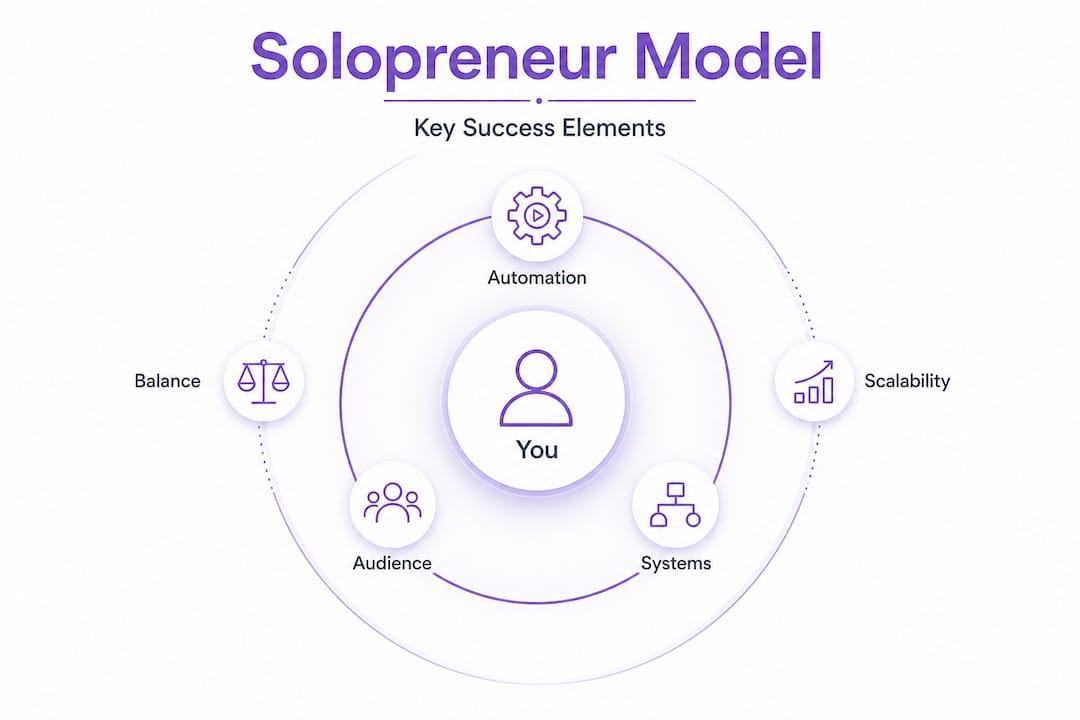
Every successful solopreneur business is built on a handful of core ingredients. Miss one, and the whole model becomes fragile. Get them right, and you create something that genuinely works for you long-term.
The core building blocks include:
- 🎯 One-person ownership with full operational control
- ⚙️ Scalable offerings such as digital products, templates, courses, or memberships
- 🤖 Automation tools that handle repetitive tasks like email sequences, invoicing, and social scheduling
- 📣 A clearly defined audience that you serve consistently
- 💰 Multiple income streams that reduce dependence on any single source
The income stream question is where most beginners get stuck. Solopreneurs who build scalable systems typically combine several revenue sources. Digital products like eBooks, templates, and Notion dashboards are popular because they require one-time creation and can sell indefinitely. Online courses and workshops generate income from expertise. Affiliate marketing earns commissions by recommending tools you already use. Subscription newsletters or membership communities create predictable monthly recurring revenue, which is the holy grail for financial stability.
Automation is the engine underneath all of it. Tools like email marketing platforms, social media schedulers, payment processors, and AI writing assistants allow a single person to operate what would otherwise require a small team. The role of AI in solo businesses has grown dramatically, with tools now capable of handling customer support drafts, content repurposing, SEO research, and even basic bookkeeping.
Pro Tip: Don’t try to automate everything at once. Pick the one task that eats the most of your time each week and automate that first. Build from there. Complexity added too early becomes a liability, not an asset.
The clearer your audience, the more effective every other element becomes. A solopreneur who serves “busy working moms who want to start a side business” will create far more resonant products, content, and offers than one who tries to serve “anyone interested in business.” Specificity is your competitive advantage when you’re operating alone.
Solopreneurship in 2026: Trends, opportunities, and real challenges
Knowing the structure of a solopreneur model, it’s critical to understand the current landscape, including both the hype and the hard realities.
The solopreneur space in 2026 looks genuinely exciting. Lower barriers to entry, powerful AI tools, and an explosion of digital platforms mean that a single motivated person can build a credible, revenue-generating business faster than ever before. Zoom has even recognized AI-powered businesses of one with its inaugural Solopreneur 50 list, signaling that the business world is taking this model seriously.
But there’s a gap between the hype and the reality. The “one-person unicorn” narrative, where a solo founder builds a multi-million dollar business entirely alone, makes for great headlines. In practice, AI enables growth but the hype often exceeds reality. Most solopreneurs build profitable lifestyle businesses, not unicorns, and that’s perfectly fine. The problem comes when people chase the unicorn story and burn out chasing metrics that don’t match their actual goals.
Here’s an honest look at what the current landscape offers:
| Opportunity |
Challenge |
| AI tools dramatically reduce operational workload |
Learning curve for new tools takes real time |
| Digital platforms give global reach from day one |
Crowded markets make differentiation harder |
| Low startup costs compared to traditional business |
Income volatility is real, especially in year one |
| Flexible work location and schedule |
Isolation and lack of peer accountability |
| Multiple income stream options |
Managing all business roles alone creates burnout risk |
| Growing cultural acceptance of solo business |
Health insurance and benefits require self-management |
Here’s a quick checklist to evaluate if solopreneurship fits your life right now:
- Do you have a marketable skill or expertise that others would pay for?
- Are you comfortable with income uncertainty for at least 6 to 12 months?
- Can you work independently without daily structure or a manager?
- Are you willing to learn basic marketing, sales, and operations?
- Do you value lifestyle flexibility more than rapid team-based growth?
- Do you have at least a small financial cushion to cover startup costs?
If you answered yes to most of these, you’re in a strong position to explore this path seriously. If several answers were no, that doesn’t mean solopreneurship is off the table. It means you have specific gaps to address before you launch.
The burnout risk deserves special attention. When you’re the marketer, the product creator, the customer service rep, and the accountant, mental fatigue builds quickly. Building rest and recovery into your business model from the start isn’t a luxury. It’s a survival strategy.
How to launch and grow as a solopreneur
If you’re inspired by new possibilities and prepared for the realities, here’s a step-by-step guide to get your solopreneur business started on the right foot.
The biggest mistake new solopreneurs make is building complex systems before they’ve validated their idea. You don’t need a polished website, a full course library, or a sophisticated email funnel on day one. You need one offer that solves a real problem for a real person, and you need to sell it before you over-engineer it.
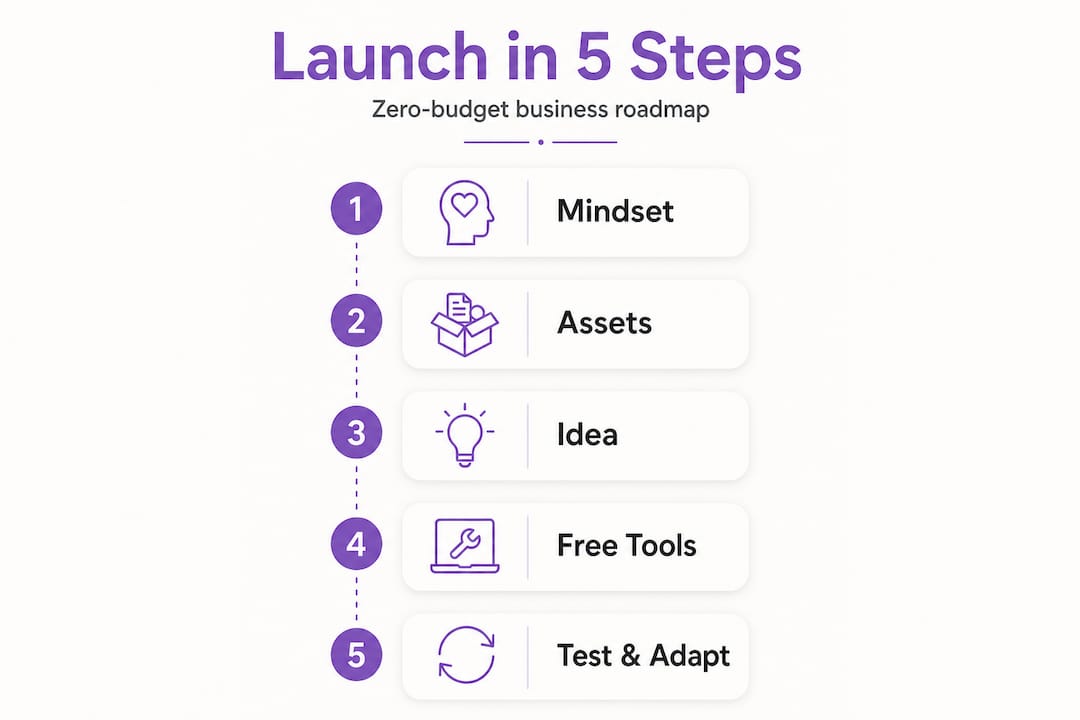
Your launch roadmap:
- Define your niche and audience. Get specific. Who exactly do you help, and what exact problem do you solve? Write it in one clear sentence.
- Validate your offer. Talk to 10 potential customers before building anything. Ask about their problems, not about your solution. Let their words shape your offer.
- Create a Minimum Viable Offer (MVO). This is your simplest, fastest-to-deliver version of your product or service. A single workshop, a template pack, or a short consulting call all qualify.
- Set up your core systems. You need a payment processor, a simple landing page, and an email list. That’s it to start. Everything else can come later.
- Acquire your first customers. Use content marketing for solopreneurs to attract organic attention, or reach out directly to your network. Your first ten customers will teach you more than any course.
- Collect feedback and optimize. After every sale, ask what worked and what didn’t. Use that feedback to improve your offer before you scale anything.
- Add automation and additional income streams. Once your core offer is validated and selling, layer in automation to reduce your time investment and add complementary income streams.
The validation step is where most people skip ahead too quickly. They spend three months building a course, launch it to silence, and conclude that solopreneurship doesn’t work. What actually happened is they built before they listened. Solopreneurs who focus on scalable systems still start with a clear, proven demand before they build the system around it.
Pro Tip: Your Minimum Viable Offer doesn’t need to be digital. A live workshop over video call, a one-page PDF guide, or even a 30-minute consulting session can validate demand faster than any automated funnel. Sell first, then systematize.
Content marketing is the most cost-effective growth channel for most solopreneurs. A consistent blog, newsletter, or social presence builds trust, attracts your ideal audience, and creates compounding visibility over time. You don’t need to be everywhere. Pick one or two channels where your audience already hangs out and show up consistently.
What most guides miss about building a solopreneur business
Here’s the uncomfortable truth that most solopreneur content won’t tell you: the people who succeed long-term are rarely the ones with the most sophisticated systems. They’re the ones with the simplest, most repeatable ones.
The internet is full of solopreneur blueprints that involve seventeen tools, complex automation sequences, and multi-funnel content strategies. Aspiring solopreneurs read these guides, feel overwhelmed, and either give up or spend months building infrastructure instead of building revenue. We’ve seen this pattern repeat constantly.
The hidden power of low-tech, easily repeatable systems is that you can actually run them. A simple weekly email newsletter you genuinely enjoy writing will outperform a complex automated sequence you built once and never touch. A single digital product you know deeply will sell better than a sprawling course library you created to look comprehensive.
The optimistic narrative around AI-powered growth is real but incomplete. Yes, AI tools can multiply your output. But they can also multiply your complexity and your distraction. The solopreneurs thriving in 2026 are not the ones using the most AI tools. They’re the ones using a few tools extremely well while staying focused on their core offer and audience.
There’s also a deeper point about lifestyle that most business content misses entirely. Solopreneurship is supposed to serve your life, not replace it. If you’re working 70-hour weeks chasing passive income, you’ve recreated the very trap you were trying to escape. We’ve found, and real stories of solopreneurs confirm this, that the people who build the most sustainable businesses are the ones who treat their own time and health as non-negotiable assets. Your energy is your most important business resource. Protect it with the same discipline you’d apply to protecting your revenue.
Balancing ambition with personal wellbeing isn’t a soft concept. It’s a hard business strategy. A burned-out solopreneur can’t create, market, or sell. A rested, focused one can do all three consistently for years.
Build your solopreneur dream with Digital Mint Art
Ready to turn inspiration into action? You’ve just covered the full landscape of the solopreneur business model, from its core principles to launch steps and the real challenges ahead. That knowledge is powerful, but the next step is finding the right resources to support your journey.
At Digital Mint Art, we’ve built a knowledge hub specifically for aspiring solopreneurs and entrepreneurs like you. Whether you’re looking for frameworks to clarify your business model, guides to sharpen your mindset, or practical tools to move faster, you’ll find solopreneur tools and resources designed to meet you exactly where you are. You can also explore encouraging stories from real people building real businesses on their own terms. Your next step starts here.
Frequently asked questions
How is a solopreneur business model different from freelancing?
Solopreneurs build systems for passive or scalable income, while freelancers sell their time directly for money. The core difference is that solopreneurs build scalable systems rather than exchanging hours for a paycheck.
Can a solopreneur business really scale without a team?
Yes, solopreneurs leverage automation and digital tools to grow income, though massive scale often still requires outside help. AI enables one-person growth, but the hype around limitless solo scaling exceeds what most people will realistically achieve.
What are the common risks of solopreneurship?
Common risks include income volatility, burnout, and the challenge of managing all business roles alone. Both optimistic and realistic views of solopreneurship acknowledge that high failure rates and low average income in early stages are real factors to plan for.
Is solopreneurship only for digital businesses?
While digital tools make it significantly easier to operate solo, solopreneurship can absolutely work in physical or hybrid models where smart systems enable one person to run operations efficiently.
Recommended
Article generated by BabyLoveGrowth